





Back to blog
Vertical vs. Horizontal Injection Molding Machines: What’s the Difference?
May 2, 2025
Ing. Andrea Balajová

When choosing an injection molding machine, one of the first decisions you’ll face is whether to go for a vertical or horizontal configuration. While both types use the same basic injection molding process, their design and application differ significantly. Choosing the right type can improve efficiency, reduce costs, and ensure better product quality.
In this article, we’ll explain the key differences between vertical and horizontal injection moulding machines, their advantages, and when each type is the better choice.
How Machine Orientation Affects Your Production
The main difference between vertical and horizontal injection molding machines lies in their orientation. This may seem like a simple design variation, but in reality, it has a major impact on production efficiency, automation, and part quality.
In horizontal injection molding machines, the mold opens sideways, allowing finished parts to be automatically ejected, often directly onto a conveyor belt. This makes horizontal machines ideal for high-volume production and fully automated manufacturing environments.
In vertical injection molding machines, the mold opens upward and downward. This allows operators (or automation systems) to easily place inserts into the mold before injection. Gravity helps keep inserts in position, which is critical for precision applications such as overmolding and insert molding.
Horizontal Injection Molding Machine
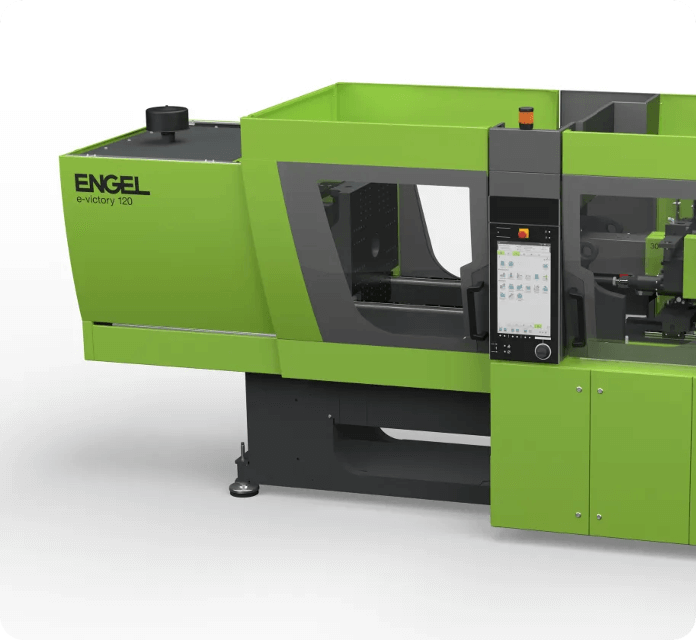
In these machines, the clamping unit and injection unit are aligned horizontally. This setup is widely used for high-volume production and standard plastic parts such as packaging, automotive components, and household products.
Key characteristics of horizontal machines:
• Easy automation and integration into production lines
• Suitable for large parts and high clamping forces
• Gravity causes parts to fall out automatically after ejection
• Ideal for fast cycle times and mass production
Horizontal machines are the industry standard because they are highly versatile and efficient for most applications. They are also easier to scale in automated environments.
Vertical Injection Molding Machine
Vertical injection molding machines operate with the clamping unit in a vertical position. This design is particularly useful for insert molding, where components such as metal parts, connectors, or electronics need to be placed into the mold before injection.
Key characteristics of vertical machines:
• Ideal for insert molding and overmolding
• Inserts can be placed easily using gravity
• Compact footprint compared to horizontal machines
• Often used with rotary tables for higher productivity
Vertical machines are commonly used in industries like electronics, automotive connectors, medical devices, and cable assemblies.
Rotary Tables, Shuttle Tables and Special Configurations in Vertical Machines
One of the biggest advantages of vertical injection molding machines is the ability to integrate special configurations that significantly improve productivity and process stability. The most common solution is the rotary table (rotary platen).
A rotary table typically has two or more stations. While one side of the machine is in the injection phase, the operator (or robot) can safely load inserts or remove finished parts on the other side. Once the cycle is complete, the table rotates, and the process continues without stopping the machine.
This setup offers several key benefits:
• Reduced idle time and higher overall productivity
• Increased operator safety
• Consistent cycle times in insert molding applications
In addition to rotary tables, vertical machines often use:
• Shuttle tables (sliding tables) for larger or heavier inserts
• Tilt tables for ergonomic loading of complex parts
• Multi-station rotary systems for high-volume insert molding
In practice, rotary table machines are widely used in automotive (connectors, sensors), electronics (cable overmolding), and medical applications. For used machinery buyers, machines with rotary tables are highly valuable, but it is important to check wear on the indexing mechanism and table alignment.
Main Differences Between Vertical and Horizontal Machines
Orientation
Horizontal machines operate side-to-side, while vertical machines operate top-to-bottom. This affects how parts are handled and how the machine fits into production.
Automation
Horizontal machines are easier to automate fully, especially in high-volume production lines. Vertical machines often require manual or semi-automated insert placement, although automation is also possible with rotary tables or robots.
Applications
Horizontal machines are best for standard plastic parts and high-output production. Vertical machines excel in insert molding and applications where precision placement of components is required.
Floor Space
Vertical machines typically take up less floor space, making them suitable for smaller production areas. Horizontal machines require more space but offer higher throughput.
Part Handling
In horizontal machines, parts are ejected automatically using gravity. In vertical machines, parts may remain in the mold and need to be removed manually or by automation.
Differences in Technical Parameters Between Vertical and Horizontal Machines
Although vertical and horizontal injection molding machines perform the same core function, their technical parameters and typical configurations differ significantly in practice.
Clamping Force
Horizontal injection molding machines are available in a much wider range of clamping forces, from small machines (around 50 tons) up to very large systems exceeding 3000 tons. They are the standard choice for large parts and high-pressure applications.
Vertical injection molding machines are typically found in the range of 20 to 500 tons, although some larger models exist. Most insert molding applications do not require extremely high clamping force, which is why vertical machines are generally smaller.
Shot Size and Injection Units
Horizontal machines usually offer larger shot sizes and more powerful injection units, making them suitable for thicker parts and larger molds. Vertical machines are often optimized for precision rather than volume, with smaller shot capacities.
Mold Size and Accessibility
Horizontal machines allow easier handling of large molds using cranes and automation. Vertical machines, on the other hand, provide better access to the mold area for insert placement, which is critical in manual or semi-automated processes.
Cycle Time and Productivity
Horizontal machines typically achieve shorter cycle times in fully automated production. Vertical machines may have slightly longer cycles due to insert handling, unless equipped with rotary or multi-station systems.
From a practical standpoint, buyers of used machines should always compare not only tonnage but also tie-bar spacing, platen size, injection capacity, and compatibility with existing molds.
Brands and How to Identify Vertical vs. Horizontal Machines
Different manufacturers specialize in different types of injection molding machines, and understanding brand positioning can help when searching for used equipment.
Horizontal machine specialists
Most major European and Japanese brands focus heavily on horizontal injection molding machines, including:
• Arburg (Allrounder series)
• Engel (e-motion, duo, victory)
• KraussMaffei (CX, GX series)
• Sumitomo (SHI) Demag (IntElect, Systec)
Vertical machine specialists
Some brands are known specifically for vertical injection molding machines and insert molding solutions:
• Engel (vertical series, insert machines)
• Arburg (vertical Allrounder V series)
• TOSHIBA / Shibaura Machine (vertical insert machines)
• Nissei (vertical FN series)
• Multiplas and other Asian manufacturers
Vertical machines are typically labeled differently. You may see designations such as:
• “V” or “Vertical” in the model name (e.g., Arburg Allrounder 375 V)
• “Insert” or “Rotary Table” in the specification
• Specific series names dedicated to vertical configurations
In contrast, horizontal machines are often identified by standard series names without special designation, as they are the default configuration.
Typical tonnage ranges by type
• Horizontal machines: 50 – 3000+ tons (most common: 100 – 800 tons)
• Vertical machines: 20 – 500 tons (most common: 50 – 200 tons)
Vertical machines are less common on the secondary market, especially with rotary tables, which makes them more valuable but also more application-specific.
Practical Insights from Production and Machine Selection
From a practical manufacturing perspective, the choice between vertical and horizontal machines is rarely just about orientation. It is about the entire production concept.
Insert stability
In vertical machines, gravity helps hold inserts in place, reducing the risk of movement during injection. In horizontal machines, inserts often require additional fixing systems, magnets, or robotic placement.
Operator dependency
Vertical machines are often more operator-dependent, especially in manual insert loading. This can introduce variability if the process is not properly controlled. Automation (rotary tables, robots) helps reduce this risk.
Maintenance considerations
Rotary tables and special mechanisms require regular maintenance. Worn bearings, misalignment, or indexing issues can affect precision and cycle time. When buying used vertical machines, these components should be carefully inspected.
Flexibility vs. productivity
Horizontal machines are typically optimized for maximum output and repeatability. Vertical machines offer higher flexibility for complex parts but may sacrifice some throughput unless properly automated.
When to Choose Vertical vs. Horizontal
Choose a horizontal machine if:
• You need high-volume production
• Your parts are large or require high clamping force
• You want fully automated production lines
• You produce standard plastic components
Choose a vertical machine if:
• You are working with inserts (metal, electronics, connectors)
• Your process requires manual or precise placement of components
• You need a compact machine footprint
• You are producing smaller, more complex assembled parts
Conclusion
Both vertical and horizontal injection molding machines have their place in modern manufacturing. The right choice depends on your production goals, part design, and level of automation.
Horizontal machines offer speed, efficiency, and scalability, making them ideal for mass production. Vertical machines provide flexibility and precision, especially for insert molding and specialized applications.
At BASTA Machines, we offer a wide range of high-quality used vertical and horizontal injection molding machines from leading brands. Whether you need a machine for high-volume production or specialized applications, we can help you find the right solution for your business.
If you’d like to see how a rotary table works in a vertical injection molding machine, this video clearly demonstrates the process and shows how it improves productivity and operator efficiency: Watch Rotary Table in Vertical Injection Molding
Looking for a reliable, ready-to-run machine?
👉 Explore our stock of used injection moulding machines here or get in touch with our team.
BUY MACHINE